
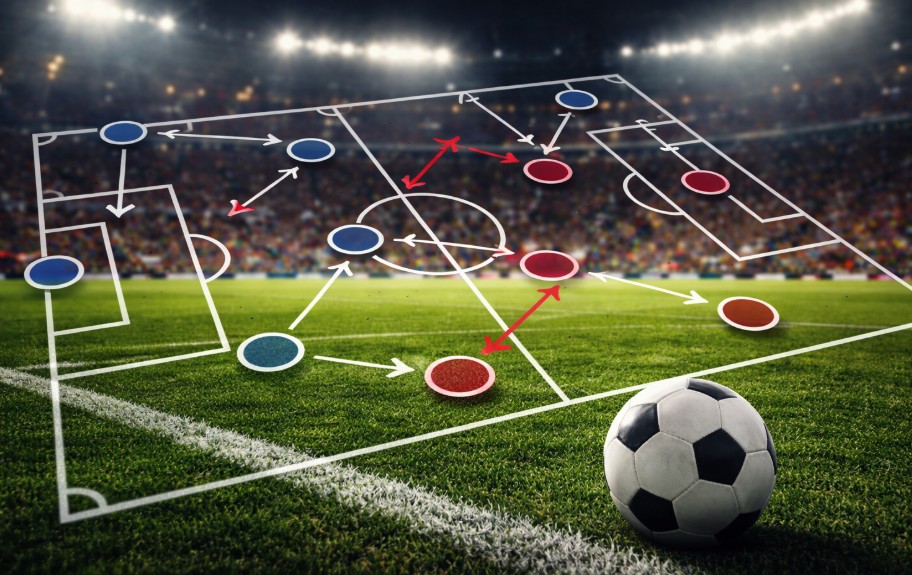
Watch a football match long enough, and you’ll notice something beyond the goals and celebrations. Players move in patterns, spaces open and close, and entire teams seem to shift shape like a living organism. That’s not accidental it’s tactics at work.
Understanding how football tactics work can completely change the way you experience the game. What once looked like chaos begins to feel structured. A simple pass becomes part of a larger plan. A defensive line stepping forward isn’t random it’s calculated.
This guide breaks down football tactics in a clear, beginner-friendly way, while still offering enough depth for those who want to go further. Whether you’re new to the sport or looking to deepen your knowledge, this article will help you see football through a more analytical lens.
What Are Football Tactics?
At its core, football tactics are the strategies teams use to win matches. These include how players position themselves, how they move with and without the ball, and how they respond to different phases of play.
Tactics operate on multiple levels:
- Team shape: The overall formation and structure
- Player roles: Individual responsibilities within the system
- Game plans: Strategies tailored to specific opponents
Think of tactics as a blueprint. While players provide the skill and execution, tactics provide direction.
How Football Tactics Work: The Basics
Formations: The Foundation of Every Team
Formations are the starting point of any tactical setup. They describe how players are arranged on the pitch, typically using numbers like 4-3-3 or 4-2-3-1.
For example:
- 4-4-2: Four defenders, four midfielders, two forwards
- 4-3-3: Four defenders, three midfielders, three attackers
- 3-5-2: Three defenders, five midfielders, two strikers
Formations are not rigid. They shift depending on whether a team is attacking, defending, or transitioning.
A 4-3-3 might look like a 2-3-5 when attacking, as full-backs push forward and midfielders advance.
In Possession vs Out of Possession
Football tactics change depending on whether a team has the ball.
In possession:
- Teams aim to create space
- Players spread out to stretch the opposition
- Passing patterns are used to break defensive lines
Out of possession:
- Teams become compact
- Players close down space and passing lanes
- Defensive shape becomes the priority
This constant shift between attack and defense is where tactics become most visible.
Transitions: The Hidden Phase
One of the most important tactical elements is transition—the moment when possession changes.
There are two types:
- Attacking transition: Winning the ball and quickly moving forward
- Defensive transition: Losing the ball and reorganizing defensively
Modern football places huge emphasis on transitions. Teams that react faster often gain a decisive advantage.
Key Tactical Concepts Explained
1. Pressing
Pressing refers to how a team tries to win the ball back.
Types of pressing include:
- High press: Pressing near the opponent’s goal
- Mid-block: Pressing in the middle third
- Low block: Defending deep and compact
High pressing can force mistakes but requires energy and coordination. A low block is safer but invites pressure.
2. Width and Depth
Good teams use the full dimensions of the pitch.
- Width: Stretching play horizontally using wingers or full-backs
- Depth: Creating vertical space by making forward runs
This forces defenders to cover more ground, creating gaps.
3. Overloads
An overload occurs when a team creates a numerical advantage in a specific area.
For example:
- 3 attackers vs 2 defenders on one side of the pitch
This increases the chances of progressing the ball or creating a chance.
4. Defensive Shape
A strong defensive structure is crucial.
Key principles include:
- Staying compact
- Maintaining line discipline
- Protecting central areas
Teams often prioritize defending the middle, forcing opponents to attack from wider, less dangerous positions.
5. Role of Space
Football is often described as a game of space.
Players constantly:
- Create space for teammates
- Exploit gaps in opposition lines
- Deny space to opponents
Understanding space is central to understanding tactics.
Breaking Down Common Formations
4-3-3: Balance and Width
One of the most popular systems in modern football.
Strengths:
- Strong attacking width
- Flexible midfield control
- Good pressing structure
Weaknesses:
- Can be exposed in midfield if not coordinated
4-2-3-1: Control and Stability
Widely used for its balance.
Strengths:
- Solid defensive base with two holding midfielders
- Creative freedom for attacking midfielder
Weaknesses:
- Can become too defensive if wingers don’t contribute
3-5-2: Midfield Dominance
A system focused on central control.
Strengths:
- Numerical advantage in midfield
- Wing-backs provide width
Weaknesses:
- Vulnerable on the flanks if wing-backs are pinned back
Practical Insights: How Tactics Play Out in Matches
When you watch a match, try focusing on patterns rather than just the ball.
Notice:
- How defenders position themselves during build-up
- Whether the team presses high or sits deep
- How midfielders rotate and cover space
- The movement of attackers without the ball
For example, a team using a high press might force turnovers near the opponent’s box, leading to quick chances.
On the other hand, a counter-attacking team may sit deep, absorb pressure, and strike quickly when space opens up.
Tips for Beginners Watching Football Tactically
If you’re new to tactical analysis, start simple:
- Watch one team at a time instead of the whole pitch
- Focus on player positioning when the ball is elsewhere
- Pay attention to shape changes during transitions
- Listen to commentary but form your own observations
Over time, patterns will become easier to recognize.
Common Mistakes and Misconceptions
“Formations Never Change”
Many beginners think a team sticks rigidly to one formation. In reality, formations are fluid and change constantly.
“More Attackers Means More Goals”
Adding more forwards doesn’t always lead to better attacking play. Without structure, teams can become unbalanced and easier to defend against.
“Defensive Football Is Negative”
Defensive tactics are often misunderstood. A well-organized defense requires discipline, intelligence, and coordination.
Some of the most successful teams in history have been built on strong defensive systems.
“Possession Equals Dominance”
Holding the ball doesn’t guarantee control of a match. Some teams deliberately allow possession, focusing instead on creating high-quality chances.
Advanced Insight: The Evolution of Football Tactics
Football tactics have evolved significantly over time.
Positional Play (Juego de Posición)
Modern teams often use structured positioning to control space and passing lanes.
Players occupy specific zones, ensuring:
- Passing options are always available
- The team remains balanced
Data and Analytics
Clubs now use advanced data to inform tactical decisions.
Metrics include:
- Expected goals (xG)
- Pressing intensity
- Passing networks
This data helps coaches refine strategies and identify weaknesses.
Hybrid Systems
Modern football rarely sticks to one system.
Teams often switch between:
- Back three and back four
- Different pressing styles
- Various attacking patterns
Flexibility has become a key tactical advantage.
Conclusion
Understanding how football tactics work opens up a deeper layer of the game. What once seemed like simple movement becomes a series of calculated decisions, shaped by strategy and intent.
From formations and pressing to space and transitions, every aspect of tactics plays a role in how matches unfold. For beginners, the key is to observe gradually focus on patterns, positioning, and decision-making.
Over time, you’ll start to see the game differently. Not just as a sequence of events, but as a tactical battle unfolding in real time.
And once that happens, football becomes far more than just a game, it becomes a story of ideas, constantly evolving with every pass and movement on the pitch.