Basketball can look chaotic at first glance; ten players sprinting, cutting, passing, and reacting in real time. But beneath that apparent chaos lies a highly structured battle of strategy and execution. Understanding how basketball offense and defense work is what transforms a casual viewing experience into something far more engaging.
Whether you’re new to the game or trying to deepen your understanding, learning the fundamentals of offensive and defensive systems reveals the “why” behind every play. Why does a team slow the pace? Why do defenders switch assignments? Why does spacing matter so much?
This article breaks it all down clearly, practically, and with enough depth to give you a real feel for how the game is played at every level.
The Fundamentals of Basketball Offense
At its core, offense in basketball is about creating high-percentage scoring opportunities. That sounds simple, but achieving it requires coordination, timing, and decision-making under pressure.
The Core Objective of Offense
Every offensive possession revolves around three primary goals:
- Create space
- Move the defense
- Find the best shot available
Teams use structured systems to achieve these goals, but even the most complex offense is built on simple principles.
Key Elements of Offensive Play
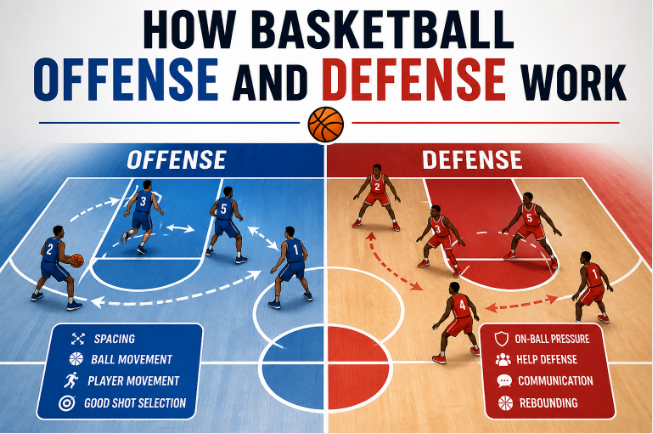
1. Spacing
Spacing refers to how players position themselves on the court. Good spacing forces defenders to cover more ground, opening up driving lanes and passing angles.
When spacing breaks down-players standing too close together—the offense becomes predictable and easy to defend.
2. Ball Movement
Passing the ball quickly and accurately forces defenders to shift constantly. The faster the ball moves, the harder it is for the defense to stay organized.
Strong offensive teams rarely rely on one player dribbling for long periods. Instead, they move the ball to find weak spots in the defense.
3. Player Movement
Offense isn’t just about the ball. Players without the ball must cut, screen, and reposition themselves to create opportunities.
Common off-ball actions include:
- Cuts to the basket
- Screens to free teammates
- Rotations to open space
4. Shot Selection
Not all shots are equal. Efficient offenses prioritize:
- Layups and dunks
- Open mid-range shots (in some systems)
- Three-point shots
The best teams consistently create high-percentage attempts rather than forcing difficult shots.
How Basketball Defense Works
If offense is about creating opportunities, defense is about taking them away. A strong defense disrupts rhythm, limits space, and forces mistakes.
The Core Objective of Defense
Defensive systems aim to:
- Prevent easy scoring chances
- Force low-percentage shots
- Create turnovers
Great defenses don’t just react—they anticipate.
Key Defensive Principles
1. On-Ball Defense
The defender guarding the player with the ball must:
- Stay in front of the attacker
- Contest shots
- Prevent easy drives
This is often the first line of defense, and a breakdown here can collapse the entire system.
2. Help Defense
Basketball is not a one-on-one defensive game. When a teammate gets beaten, others must rotate to help.
Help defense involves:
- Sliding into driving lanes
- Protecting the rim
- Recovering quickly to original assignments
3. Communication
Defensive success depends heavily on communication. Players constantly call out:
- Screens
- Switches
- Rotations
Without communication, even talented defenders can become disorganized.
4. Rebounding
A defensive possession isn’t complete until the team secures the rebound. Allowing second-chance opportunities can undo otherwise strong defensive efforts.
Types of Basketball Offense
Different teams use different offensive systems depending on their personnel and philosophy.
Half-Court Offense
This is a structured system used when the defense is set. It emphasizes:
- Set plays
- Screens and cuts
- Controlled ball movement
Half-court offense requires discipline and patience.
Fast Break Offense
This occurs immediately after gaining possession, usually following a steal or rebound.
The goal is simple:
- Score before the defense sets up
Fast breaks rely on speed, quick decision-making, and precise passing.
Motion Offense
A fluid system where players constantly move without relying heavily on set plays.
Key features:
- Continuous cuts and screens
- Read-and-react decisions
- Less predictability
Motion offense is widely used because it adapts to defensive behavior.
Types of Basketball Defense
Just like offense, defensive strategies vary widely.
Man-to-Man Defense
Each defender is assigned a specific player to guard.
Advantages:
- Strong accountability
- Better pressure on individual players
Challenges:
- Requires high individual defensive skill
Zone Defense
Defenders guard areas rather than specific players.
Common formations:
- 2-3 zone
- 3-2 zone
Advantages:
- Protects the paint
- Useful against teams with poor shooting
Challenges:
- Vulnerable to outside shooting
- Requires strong coordination
Press Defense
Applied across the full court to pressure the offense.
Goals:
- Force turnovers
- Disrupt offensive rhythm
Press defense is aggressive but can be risky if broken.
Key Concepts That Tie Offense and Defense Together
Understanding how basketball offense and defense work requires recognizing how each side reacts to the other.
Offensive Concepts
- Spacing stretches the defense
- Ball movement forces defensive rotation
- Screens create mismatches
- Tempo controls the pace of the game
Defensive Concepts
- Containment limits penetration
- Rotation covers breakdowns
- Anticipation creates turnovers
- Physicality disrupts timing
The game becomes a constant chess match—every offensive action has a defensive counter.
Practical Insights: What to Watch During a Game
If you want to understand basketball more deeply, focus on specific details rather than just the ball.
Watch Off-Ball Movement
Notice how players move when they don’t have the ball. This is often where plays are created.
Observe Defensive Rotations
When one defender helps, another must rotate. Watching this chain reaction reveals how organized a defense is.
Pay Attention to Spacing
Look at how far apart players are. Good spacing often leads to better scoring opportunities.
Identify Mismatches
Teams frequently target weaker defenders or size mismatches. Recognizing this helps explain offensive decisions.
Common Mistakes and Misconceptions
Even regular viewers often misunderstand key aspects of the game.
Good Defense Means Blocking Shots
Shot-blocking is only a small part of defense. Positioning, anticipation, and discipline are far more important.
Isolation Is the Best Offense
While one-on-one play can be effective, over-reliance on isolation often stalls ball movement and reduces efficiency.
More Scoring Means Better Offense
High-scoring teams aren’t always efficient. Shot quality and decision-making matter more than raw point totals.
Zone Defense Is Easier
Zone defense requires constant awareness and communication. It’s not a shortcut it’s a different challenge.
Advanced Insight: Modern Trends in Basketball Strategy
Basketball strategy has evolved significantly, especially in recent years.
Emphasis on Three-Point Shooting
Modern offenses prioritize spacing and outside shooting. This forces defenses to stretch, opening driving lanes.
Positionless Basketball
Traditional roles (point guard, center, etc.) are becoming less rigid. Players are expected to:
- Handle the ball
- Shoot from distance
- Defend multiple positions
Switching Defenses
Many teams now switch defensive assignments on screens instead of fighting through them. This reduces open shots but requires versatile defenders.
Analytics-Driven Decisions
Teams increasingly rely on data to guide strategy, focusing on:
- Shot efficiency
- Player matchups
- Pace of play
This has reshaped both offensive and defensive approaches at every level.
Conclusion
Understanding how basketball offense and defense work opens up an entirely new way of watching the game. What once seemed like random movement becomes a series of calculated decisions—each pass, cut, and rotation serving a purpose.
Offense is about creating opportunity through spacing, movement, and precision. Defense is about disrupting that flow with discipline, awareness, and teamwork. Neither exists in isolation; each constantly adapts to the other.
For beginners, these concepts provide a foundation. For more experienced fans, they offer a deeper appreciation of the strategy behind every possession. And once you start seeing the patterns, the game becomes far more than just scoring—it becomes a conversation between two competing systems, unfolding in real time.