
Baseball can feel deceptively simple at first glance hit the ball, run the bases, score runs. But for new fans, the scoring system often raises more questions than answers. Why isn’t every hit a run? What counts as an RBI? And how do errors factor into the game?
Understanding how baseball scoring works is the key to appreciating the strategy, nuance, and rhythm of the sport. Whether you’re watching a local game or tuning into Major League Baseball, this guide will walk you through the fundamentals in a clear, practical way without oversimplifying the game’s depth.
The Basics of Baseball Scoring
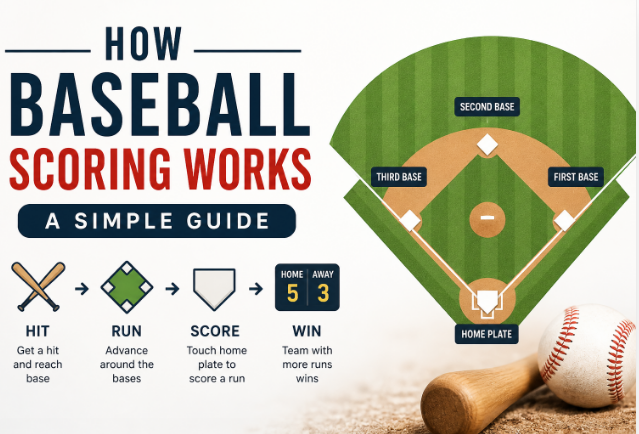
At its core, scoring in baseball revolves around one simple objective: a team scores a run when a player safely reaches home plate after touching all four bases in order.
Each team takes turns batting and fielding across nine innings. During their turn at bat, a team attempts to get runners on base and bring them home to score.
The Four Bases Explained
- First Base – The batter’s initial destination after hitting the ball
- Second Base – The midpoint of the infield
- Third Base – The final step before scoring
- Home Plate – Where runs are scored
A run is officially counted when a player successfully touches all four bases without being put out.
How a Player Scores a Run
Scoring a run isn’t always as straightforward as hitting the ball and sprinting around the bases. Most runs are the result of teamwork and sequencing.
Common Ways to Score
- Base Hits
- A batter hits the ball and safely reaches base
- Teammates already on base advance and may score
- Home Runs
- The batter hits the ball out of the field of play in fair territory
- All runners, including the batter, automatically score
- Walks and Hit-by-Pitch
- If bases are loaded, a walk or hit-by-pitch forces a runner home
- Sacrifice Plays
- A batter intentionally makes an out to advance a runner (often leading to a run)
- Errors by Fielders
- Defensive mistakes can allow runners to advance and score
Each of these scenarios contributes to the total runs a team accumulates during a game.
Understanding RBIs (Runs Batted In)
One of the most important individual statistics in baseball is the RBI, or Run Batted In.
What Is an RBI?
A batter earns an RBI when their action at the plate directly leads to a run being scored—except in certain situations like errors.
Examples of RBIs:
- A single that allows a runner to score
- A sacrifice fly that brings a runner home
- A home run (counts as at least one RBI)
Situations That Typically Do NOT Count:
- Runs scored due to fielding errors
- Double plays (depending on context)
RBIs are often used to measure a player’s effectiveness in clutch situations, though analysts sometimes debate their value due to their dependence on team context.
Outs and Their Impact on Scoring
A team only has three outs per inning to score runs. Once three outs are recorded, the teams switch roles.
Types of Outs
- Strikeouts – The batter fails to hit the ball within three strikes
- Flyouts – A fielder catches the ball before it hits the ground
- Groundouts – The ball is fielded and thrown to a base before the runner arrives
- Force Outs – A runner is forced out due to base advancement rules
The limited number of outs creates pressure. Teams must balance aggression with caution, deciding when to take risks to score.
Key Scoring Plays Explained
Singles, Doubles, Triples
These terms describe how far a batter reaches safely:
- Single – Reaches first base
- Double – Reaches second base
- Triple – Reaches third base
Each type of hit increases the likelihood of scoring, especially when runners are already on base.
Home Runs
The most straightforward scoring play. A home run guarantees at least one run and can bring in up to four runs if the bases are loaded—a “grand slam.”
Famous moments like those in the World Series often hinge on timely home runs.
The Role of the Scorekeeper
Behind every game is an official scorekeeper responsible for recording what happens on the field.
What Do Scorekeepers Track?
- Hits and types of hits
- Runs scored
- RBIs
- Errors
- Pitching statistics
One of the most debated decisions a scorekeeper makes is whether a play is ruled a hit or an error. This distinction can affect both individual stats and how a run is categorized.
Errors and Unearned Runs
Not all runs are created equal in baseball scoring.
What Is an Error?
An error occurs when a fielder makes a mistake that allows a batter or runner to advance when they otherwise would have been out.
Earned vs. Unearned Runs
- Earned Runs – Result from normal gameplay without defensive mistakes
- Unearned Runs – Occur due to errors or passed balls
This distinction is especially important for pitchers, as it affects their ERA (Earned Run Average)—a key performance metric.
Key Concepts Made Simple
To summarize some of the most important scoring elements:
- Run: A player successfully reaches home plate
- RBI: A batter contributes directly to a run scoring
- Out: One of three chances a team has before switching sides
- Hit: A successful attempt to reach base via batting
- Error: A defensive mistake allowing advancement
Understanding these basics provides a solid foundation for following any game.
How Scoring Plays Out in Real Games
Baseball scoring is deeply tied to strategy. Managers and players constantly make decisions based on the situation.
Situational Hitting
A batter may adjust their approach depending on:
- Number of outs
- Position of runners
- Score of the game
For example, with a runner on third and less than two outs, a batter might aim for a sacrifice fly—a controlled out that still scores a run.
Base Running Decisions
Runners must decide:
- When to advance
- When to stay put
- When to attempt stealing a base
Aggressive base running can create scoring opportunities, but it also increases the risk of outs.
Tips for Beginners Watching a Game
If you’re new to baseball, scoring can feel overwhelming at first. Here are a few practical ways to follow along:
- Watch the base runners, not just the ball
- Pay attention to the number of outs
- Notice how teams react in scoring situations
- Listen to commentary for context
Over time, patterns begin to emerge, and the game becomes much easier to read.
Common Mistakes and Misconceptions
Even casual fans sometimes misunderstand key aspects of baseball scoring.
Every Hit Should Score a Run”
Not necessarily. A hit only advances runners—it doesn’t guarantee a run unless it allows someone to reach home.
Errors Don’t Matter Much”
Errors can completely change the outcome of a game. They extend innings, create scoring chances, and lead to unearned runs.
RBIs Mean Everything”
While RBIs are valuable, they depend heavily on opportunity. A great hitter on a weak team may have fewer RBIs simply due to fewer chances.
Advanced Insight: The Evolution of Scoring Analysis
Modern baseball has embraced analytics, changing how scoring is evaluated.
Sabermetrics and Run Creation
Analysts now use advanced stats like:
- On-base percentage (OBP)
- Slugging percentage (SLG)
- OPS (On-base + Slugging)
These metrics provide a clearer picture of how players contribute to scoring beyond traditional stats like RBIs.
Run Expectancy Models
Teams analyze the probability of scoring based on:
- Number of outs
- Runner positions
This data influences in-game decisions, from batting strategies to defensive alignments.
Organizations like Oakland Athletics famously helped popularize data-driven approaches, reshaping how scoring efficiency is understood across the sport.
Why Understanding Scoring Matters
Baseball isn’t just about action it’s about anticipation. Knowing how scoring works allows you to:
- Appreciate strategic decisions
- Understand player value
- Follow the flow of the game more closely
It turns a slow-paced contest into a layered, tactical experience.
Conclusion
Learning how baseball scoring works opens the door to a deeper appreciation of the game. What starts as a simple objective—getting runners home quickly reveals itself as a complex interplay of skill, timing, and decision-making.
From RBIs and home runs to errors and advanced analytics, every run tells a story. And once you understand how those runs are created, you’re no longer just watching baseball—you’re reading it in real time.
Whether you’re a beginner or looking to sharpen your knowledge, mastering the basics of scoring is the first step toward truly enjoying the sport.