Ice hockey moves fast, blindingly fast. For new fans, that speed can make it difficult to follow what actually matters most: how teams score and how those goals are counted. Understanding the basics of scoring doesn’t just make games easier to watch; it reveals the strategy, structure, and subtle brilliance behind one of the world’s most dynamic sports.
In this guide, we’ll break down how ice hockey scoring works in a clear, simple way. Whether you’re watching your first game or looking to deepen your understanding, this article will give you the tools to follow the action with confidence.
What Counts as a Goal in Ice Hockey?
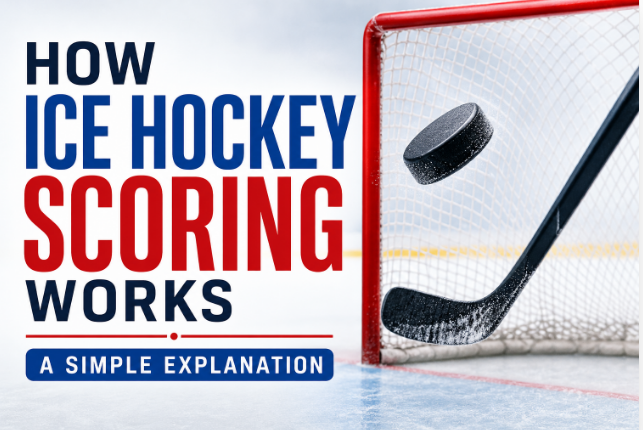
At its core, scoring in ice hockey is straightforward: a team earns one point—called a goal—when the puck completely crosses the opponent’s goal line inside the net.
That might sound simple, but there are important conditions:
- The puck must fully cross the goal line
- The goal must be scored legally (no rule violations)
- The puck cannot be kicked or thrown into the net deliberately
- The stick used must be below the crossbar when making contact
Officials, often with video review, ensure every goal meets these standards—especially in high-level leagues like the National Hockey League.
Breaking Down How Ice Hockey Scoring Works
The Basic Scoring System
Unlike sports with multiple scoring values (like basketball or rugby), ice hockey uses a simple system:
- Each goal = 1 point
- The team with the most goals at the end of the game wins
Games are typically divided into three periods, each lasting 20 minutes. If the score is tied at the end of regulation, overtime or shootouts may decide the winner.
What Is an Assist?
Scoring doesn’t happen in isolation. Ice hockey rewards teamwork through assists.
- Up to two assists can be awarded per goal
- Assists go to the players who passed the puck to the goal scorer
- The sequence must directly contribute to the goal
For example:
- Player A passes to Player B
- Player B passes to Player C
- Player C scores
Player A and Player B each receive an assist, while Player C gets the goal.
This system highlights the collaborative nature of hockey, where playmaking is just as valuable as finishing.
Points vs Goals: Understanding Player Stats
In hockey, a player’s offensive contribution is often measured in points, not just goals.
- Points = Goals + Assists
So if a player scores 25 goals and has 40 assists, they have 65 points.
This is why legendary players like Wayne Gretzky are remembered not just for scoring, but for creating opportunities.
Types of Goals in Ice Hockey
Not all goals are created equal. While each counts as one point, the type of goal adds context and strategic importance.
Even-Strength Goals
These occur when both teams have the same number of players on the ice (typically 5-on-5).
- Most common type of goal
- Reflects standard gameplay conditions
Power Play Goals
A power play happens when one team has more players due to an opponent’s penalty.
- Usually 5 attackers vs 4 defenders
- The attacking team has a higher chance to score
A power play goal is scored during this advantage.
Short-Handed Goals
This is the opposite of a power play goal.
- Scored by the team that is down a player due to a penalty
- Less common, but often game-changing
Short-handed goals are especially impressive because they require defensive awareness and quick counterattacks.
Empty-Net Goals
When a team is trailing late in a game, they may remove their goalie to add an extra attacker.
- Leaves the net unguarded
- Opponents can score easily from distance
These are called empty-net goals and often seal the outcome of a match.
Overtime and Shootout Goals
If a game is tied after regulation:
- Overtime: Sudden-death format (first goal wins)
- Shootout: Players take turns attempting to score against the goalie
Shootout goals count toward the final result but do not count toward individual player stats.
Key Concepts That Make Scoring Easier to Understand
To truly grasp how ice hockey scoring works, it helps to break down a few core ideas:
1. The Role of Positioning
- Offensive players position themselves to receive passes and create scoring chances
- Defenders try to block shots and protect the goal area
2. Shot Types
- Wrist shot: Quick and accurate
- Slap shot: Powerful but slower to execute
- Backhand: Used in tight spaces
Different shots influence scoring success depending on the situation.
3. Goaltending Impact
The goalie is the final barrier.
- Elite goalies can stop over 90% of shots
- Scoring often depends on creating difficult angles or rebounds
4. Rebounds and Deflections
Many goals aren’t clean shots.
- Rebounds occur when a goalie stops the puck but doesn’t control it
- Deflections redirect shots mid-air, making them harder to stop
Practical Insights: How Scoring Plays Out in Real Games
Watching hockey becomes much more engaging once you recognize scoring patterns.
Offensive Strategy
Teams don’t just shoot randomly. They:
- Cycle the puck to tire out defenders
- Look for openings near the goal crease
- Create traffic in front of the goalie
The goal is to force defensive mistakes or obscure the goalie’s vision.
Defensive Strategy
Preventing goals is just as important.
- Blocking shooting lanes
- Clearing rebounds quickly
- Maintaining tight coverage
Strong defensive teams limit high-quality scoring chances, not just total shots.
Special Teams Matter
Power plays and penalty kills can decide games.
- Teams with efficient power plays often have higher scoring rates
- Strong penalty-killing units prevent momentum swings
In professional leagues like the National Hockey League, special teams are a major differentiator between contenders and average teams.
Common Mistakes and Misconceptions
Even regular viewers sometimes misunderstand key aspects of scoring.
More Shots Means More Goals”
Not necessarily.
- Quality matters more than quantity
- A team can outshoot an opponent but still lose
All Goals Are Equal in Impact”
While each goal counts the same, context matters.
- A short-handed goal can shift momentum dramatically
- A late-game goal often carries more pressure
Assists Are Less Important
This is a common misconception.
- Playmakers drive offensive success
- Many goals depend on precise passing sequences
Goalies Are Only Defensive Players
Modern goalies contribute more than just saves.
- They handle the puck behind the net
- They help initiate plays
Advanced Insight: The Evolution of Scoring in Modern Hockey
Scoring trends have changed over time, especially with analytics becoming more influential.
Expected Goals (xG)
Advanced stats now measure scoring probability.
- Based on shot location, angle, and type
- Helps evaluate scoring chances beyond raw numbers
Pace and Space
Modern hockey emphasizes:
- Faster transitions
- More open ice
- Increased offensive creativity
This has led to more dynamic scoring opportunities compared to earlier eras.
Rule Changes and Their Impact
Leagues have adjusted rules to encourage scoring:
- Reducing obstruction penalties
- Increasing power play opportunities
- Modifying overtime formats
These changes aim to make the game more exciting and offense-driven.
Why Understanding Ice Hockey Scoring Matters
Once you understand how ice hockey scoring works, the game transforms.
You start to notice:
- Why certain plays develop
- How teams exploit weaknesses
- What separates elite players from average ones
Instead of just watching the puck, you begin to read the game itself.
Conclusion
Ice hockey scoring may seem simple on the surface just get the puck into the net—but the reality is far more nuanced. From assists and special teams to shot quality and advanced analytics, scoring reflects the full complexity of the sport.
For beginners, the key takeaway is this: every goal tells a story. It’s the result of positioning, teamwork, timing, and execution under pressure.
As you watch more games, these details become clearer, and the sport becomes far more rewarding to follow. Understanding how scoring works isn’t just about keeping track of the score—it’s about appreciating the craft behind every play.