
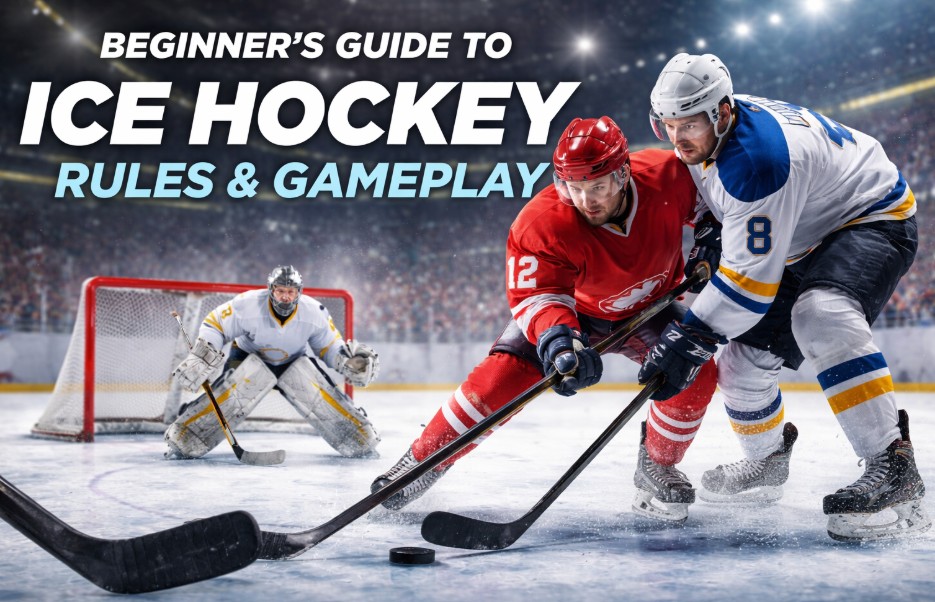
Ice hockey can feel chaotic at first glance, players flying across the ice, rapid line changes, and a puck that seems to vanish and reappear in an instant. But beneath that speed lies a structured, tactical sport with clearly defined rules and rhythms. This Beginner’s Guide to Ice Hockey Rules and Gameplay is designed to break down the essentials in a way that’s easy to follow, while still offering enough depth to help you appreciate what’s really happening on the ice.
Whether you’re watching your first game or trying to deepen your understanding, learning how hockey works transforms it from a blur into one of the most compelling sports in the world.
The Basics of Ice Hockey
At its core, ice hockey is a team sport played between two sides, each trying to score goals by shooting a puck into the opponent’s net. A standard team has six players on the ice at a time: three forwards, two defensemen, and one goaltender.
The game is typically divided into three periods, each lasting 20 minutes of play time. Unlike many sports, the clock stops frequently—after goals, penalties, and when the puck leaves play—so games often last longer than an hour in real time.
Professional leagues like the National Hockey League follow these rules closely, though there are slight variations across international and amateur levels.
The Ice Rink and Player Positions
Before diving into gameplay, it helps to understand the layout of the rink and the roles players perform.
The Rink Structure
An ice hockey rink is divided into three main zones:
- Defensive Zone: The area closest to your own goal
- Neutral Zone: The middle section between the blue lines
- Offensive Zone: The area where your team attempts to score
Blue lines separate these zones, and they play a critical role in rules like offsides.
Player Positions Explained
Each position has a defined responsibility:
- Forwards (Center, Left Wing, Right Wing)
Focus on scoring and offensive play. The center often leads faceoffs and plays both ends of the ice. - Defensemen
Protect their own goal and disrupt opposing attacks, while also helping initiate plays from the back. - Goaltender (Goalie)
The last line of defense, tasked with stopping shots using specialized equipment and positioning.
Understanding these roles helps make sense of player movement and strategy during a game.
Core Ice Hockey Rules Explained
1. Offside Rule
One of the most important and confusing, rules for beginners.
A team is offside if a player enters the offensive zone before the puck crosses the blue line. In simple terms:
- The puck must enter the zone first
- Players must follow it in
If they don’t, play is stopped and a faceoff occurs in the neutral zone.
2. Icing Rule
Icing occurs when a player shoots the puck from behind the center red line across the opponent’s goal line without it being touched.
Key points:
- Play is stopped and brought back to the defensive zone
- It prevents teams from simply clearing the puck to relieve pressure
- The defending team cannot change players after icing
3. Faceoffs
Faceoffs restart play after stoppages. Two players face each other, and the puck is dropped between them.
Faceoffs occur at designated spots depending on why play stopped—center ice after goals, or in specific zones after penalties or offsides.
Penalties and Power Plays
Penalties are central to ice hockey gameplay and can dramatically shift momentum.
Common Penalties
- Tripping: Using a stick or body to knock an opponent off balance
- Hooking: Using the stick to impede a player’s movement
- Slashing: Swinging the stick at an opponent
- Holding: Grabbing or restraining a player
- High-Sticking: Contacting an opponent above the shoulders
Most minor penalties result in two minutes in the penalty box.
Power Play and Penalty Kill
When a team commits a penalty:
- The penalized team plays with fewer players (usually 5 vs. 4)
- The opposing team has a power play, increasing their scoring chances
- The penalized team attempts a penalty kill, focusing on defense
This dynamic creates some of the most strategic moments in hockey.
How Scoring Works
A goal is scored when the puck fully crosses the goal line between the posts and under the crossbar.
However, not all goals count. Disallowed goals can occur due to:
- Offside play
- Goaltender interference
- High stick contact with the puck
Referees may review goals using video replay to ensure accuracy.
Key Gameplay Flow and Strategy
Ice hockey is unique in its continuous flow. Teams transition rapidly between offense and defense, often within seconds.
Line Changes
Players rotate in and out frequently, often every 30–60 seconds. These “line changes” happen on the fly, without stopping play, requiring coordination and awareness.
Breakouts and Forechecking
- Breakout: Moving the puck from the defensive zone to offense
- Forechecking: Applying pressure in the offensive zone to regain possession
These tactics define how teams control the pace of the game.
Key Concepts Every Beginner Should Know
To simplify things, here are the core ideas that shape ice hockey gameplay:
- Possession matters more than time: Teams focus on controlling the puck rather than just holding territory
- Spacing is critical: Players maintain structure to support both offense and defense
- Speed creates advantage: Quick transitions often lead to scoring chances
- Special teams decide games: Power plays and penalty kills can swing outcomes
These principles apply across all levels, from amateur leagues to elite competitions.
Practical Insights: Watching and Understanding Real Games
Once you know the basics, watching hockey becomes far more engaging.
What to Watch For
- Puck movement: Notice how teams cycle the puck to create openings
- Defensive positioning: Watch how defenders block lanes and protect the net
- Goaltender technique: Observe positioning rather than just saves
- Player spacing: Good teams rarely bunch up; they spread the ice effectively
Tips for Beginners
- Focus on one zone at a time instead of tracking the puck constantly
- Watch replays to understand how goals develop
- Listen to commentary for rule explanations and strategy insights
With time, patterns start to emerge, and the game slows down mentally.
Common Mistakes and Misconceptions
Even regular viewers can misunderstand aspects of ice hockey.
“It’s Just Random Chaos”
While it may look frantic, hockey is highly structured. Systems like forechecking schemes and defensive formations dictate player movement.
“Fighting Is a Core Part of the Game”
Fighting exists but is not central to modern hockey. In fact, leagues like the International Ice Hockey Federation discourage it heavily.
“More Shots Always Mean Better Offense”
Shot quality matters more than quantity. A well-placed shot from a high-danger area is far more valuable than multiple low-percentage attempts.
Advanced Insight: Modern Trends in Ice Hockey Strategy
As analytics have become more prominent, hockey strategy has evolved significantly.
Emphasis on Possession Metrics
Teams now track advanced stats like:
- Corsi: Measures shot attempts to estimate puck possession
- Expected Goals (xG): Evaluates scoring chances based on shot quality
These metrics help teams assess performance beyond traditional stats.
Positionless Play
Modern hockey is becoming more fluid. Defensemen join attacks, and forwards drop back defensively, blurring traditional roles.
Speed and Skill Over Physicality
While physical play still matters, today’s game prioritizes speed, agility, and puck-handling skills. This shift has made the sport faster and more accessible to new fans.
Conclusion
Ice hockey may seem complex at first, but its structure becomes clear once you understand the fundamental rules and gameplay principles. From offsides and icing to power plays and positional strategy, each element plays a role in shaping the flow of the game.
This Beginner’s Guide to Ice Hockey Rules and Gameplay offers a foundation that turns confusion into clarity. With a bit of practice and observation, you’ll start to see the patterns, appreciate the tactics, and enjoy the sport on a deeper level.
Like many great sports, hockey rewards those who invest time in understanding it. And once it clicks, few games match its speed, intensity, and strategic depth.
