
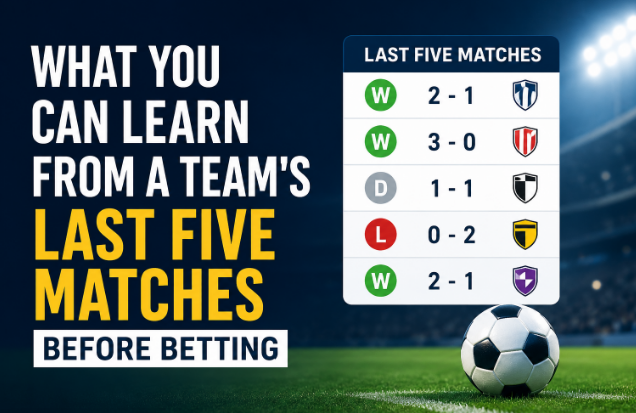
There’s a reason pundits, managers, and analysts always come back to recent form. The last five matches a team has played are one of the most accessible and revealing tools available to anyone trying to understand where a club currently stands not where they were in September, not what their squad looked like two transfer windows ago, but right now. If you’re trying to figure out what you can learn from a team’s last five matches before betting, the honest answer is: quite a lot, provided you know what to actually look for. Raw results only scratch the surface. This article digs into the layers underneath – goals, patterns, momentum, and the context that separates useful insight from misleading noise.
Results Alone Don’t Tell the Full Story
The first instinct when checking recent form is to scan the W-D-L column and draw a quick conclusion. Three wins out of five looks good; one win out of five looks bad. But that reading can lead you badly astray if you stop there.
Consider Newcastle United’s 2023/24 run where they were dealing with a congested schedule and significant injury problems. Their results across certain five-game stretches looked mediocre on paper, yet the underlying performances — shots on target, chances created, territorial dominance – told a very different story about a squad being stretched thin rather than one in genuine decline. Conversely, a team can pick up back-to-back wins against poor opposition and look deceptively healthy heading into a much tougher fixture.
The result is the headline. What happened during the match is the actual story. Treat wins and losses as a starting point, not a conclusion.
Goals Scored and Conceded – Look at the Numbers Behind the Numbers
Once you move past the scoreline, the next layer is goals: how many a team has been scoring, and how many they’ve been letting in. A side that has scored ten goals across their last five matches is clearly in good attacking rhythm. A team that has kept three clean sheets in that same window is defensively well-organised. But again, the numbers need context.
Where were those goals coming from? A team scoring heavily from set pieces might suddenly become less potent if their first-choice centre-back – who leads their aerial threat from corners picks up a knock. A side conceding late goals repeatedly might be running out of steam physically, which has implications for matches that go beyond the 70-minute mark.
It’s also worth noting the score-lines themselves. There’s a meaningful difference between a team that’s been winning 3–1 and 4–0, and one scraping past opponents 1–0 on a deflected effort. Tottenham Hotspur have had periods in recent seasons where their results flattered a side that was being outplayed for large portions of games – the kind of pattern that tends to correct itself over time.
Expected goals (xG) data, which is now widely available on sites like FBref or Sofascore, can help you understand whether a team’s scoring output reflects genuine quality or a run of fortune in front of goal. You don’t need to be a data analyst to find it useful – even a basic look at whether a team is consistently over- or underperforming their xG is informative.
Momentum, Confidence, and the Psychology of Form
Football is as much a mental game as a physical one, and form has a psychological dimension that often goes unacknowledged in betting analysis. Teams on winning runs play with a certain confidence – they press higher, take risks in the final third, and tend to find solutions when games get tight. Teams on poor runs can hesitate at crucial moments, lose their defensive shape under pressure, and visibly lack the belief to chase a game when they fall behind.
Leicester City’s title-winning season in 2015/16 was built on a run of form that fed on itself – players believed, the momentum was tangible, and that belief contributed to results that the raw squad quality alone couldn’t fully explain. On the flip side, you’ve probably seen clubs in a poor patch concede a soft goal and visibly collapse.
When a team has won three or four of their last five, especially in competitive fixtures, that confidence factor is real and worth factoring in. Similarly, when a side has been struggling – particularly if they’ve conceded late or bottled leads, the psychological weight of that can show up in their next performance even if the XI looks unchanged on paper.
The Quality of Opposition Faced
This is perhaps the most overlooked element when bettors look at a team’s recent five matches. A five-game unbeaten run sounds impressive until you realise four of those opponents were in the bottom half of the table and the fifth was a cup tie against a lower-division side. That same run means something completely different if it came against top-six opposition.
Before drawing conclusions from recent form, map out who those five opponents actually were and where they sit competitively. It adds a crucial weighting to everything else you’ve observed. Brighton under Roberto De Zerbi, for example, earned a reputation for performing well against stronger sides while occasionally dropping unexpected points against teams who sat deep and were difficult to break down – knowing that about a team’s profile helps you assess their last five matches in proper context rather than just counting the points.
The upcoming opponent matters just as much. A team in brilliant form against open, attack-minded sides might be stepping into a completely different challenge against a low-block defensive team. Form is relative, and so is the test ahead.
Conclusion
The last five matches a football team has played can tell you a great deal but only if you read them carefully. Start with the results, then dig into the goals scored and conceded, the quality of those performances, and the opponents involved. Factor in momentum and confidence as genuine forces in a team’s current state. Cross-reference the level of opposition they’ve faced before deciding how much weight to give that run of form. None of this leads to certainty, but it builds a picture that’s far more grounded than a gut feeling or a league table glance. Betting with that level of preparation puts you in a much better position to make decisions you can actually reason through.
Disclaimer: This article is for educational purposes only and is not intended as financial or betting advice. Football betting involves risk, and past performance – whether a team’s or a bettor’s – does not guarantee future results. Always bet within your means, and if gambling is becoming a problem, please reach out to a responsible gambling support service in your country.