If you’ve spent any time browsing a football betting site, you’ve probably seen the term “double chance” sitting quietly in the markets tab. Most beginners scroll past it without a second thought and that’s a shame, because understanding what double chance betting means could genuinely change how you approach certain matches. This article breaks down the concept from scratch, explains the trade-offs involved, and helps you figure out when it actually makes sense to use it.
What Is Double Chance Betting?
In a standard football match, there are three possible results: home win, draw, or away win. When you place a regular 1X2 bet, you’re picking just one of those outcomes. Double chance betting lets you cover two of the three outcomes with a single bet.
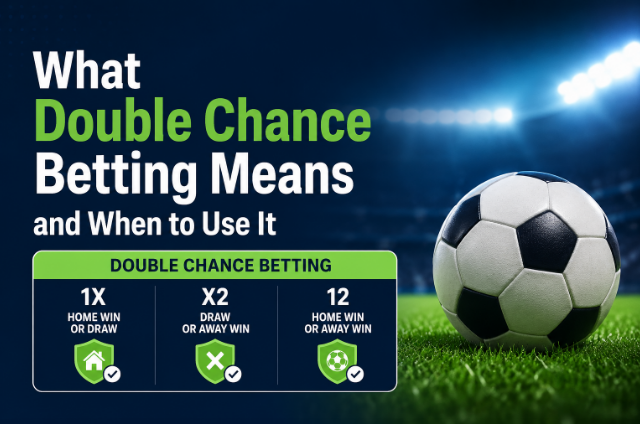
There are three double chance combinations available on any match:
The first is 1x – you win if the home team wins or if the match ends in a draw. The second is 12 – you win if either team wins, meaning a draw is the only result that beats you. The third is x2 – you win if the away team wins or if the match ends in a draw.
Think of it like this: instead of backing Arsenal to beat Chelsea, you’re backing Arsenal not to lose. It’s a wider net, and that wider net comes with a cost the odds will always be lower than a straight win bet, because you’re taking on less risk.
How the Odds Work and What You’re Trading
The trade-off with double chance bets is straightforward. You gain coverage, but the bookmaker adjusts the odds accordingly. If Arsenal are priced at 2.10 to beat Chelsea outright, their double chance price (1X) might sit around 1.35 or 1.40. You’re essentially sacrificing potential profit for a better chance of collecting a return.
Take the 2023 Champions League final between Manchester City and Inter Milan. City were clear favourites. If you backed them on the 1X double chance market, you’d have covered both a City win and a draw – which meant you’d only lose if Inter won outright. That extra cushion cost you on the odds, but for bettors who felt confident City wouldn’t lose without being entirely sure they’d win in 90 minutes, it was a sensible middle ground.
This is the core logic: double chance bets suit situations where you’re more confident about one team not losing than you are about them winning specifically.
When Double Chance Betting Makes the Most Sense
Not every match calls for this market, but there are specific situations where it fits naturally.
One common scenario is when a strong favourite is playing away from home. Away games are unpredictable even top sides drop points in difficult atmospheres. If you believe Liverpool will avoid defeat at Wolves but aren’t confident they’ll win comfortably, the X2 (away win or draw) market covers you in a way a straight win bet doesn’t.
Another situation is when a match has a high probability of being tight and competitive. Think of a local derby say, an Everton vs Liverpool match or a Manchester derby. These games rarely produce comfortable wins for either side, and a draw is always on the cards. Backing the 12 option (either team to win) cuts out the draw as a losing result and can be useful when you simply want action on the match without the draw killing your bet.
Double chance markets also work well as part of accumulator bets. Including a double chance selection instead of a straight win in a five-fold accumulator can make the whole bet more stable, particularly if one fixture looks too close to call on the outright result.
When It Probably Isn’t Worth Using
There are situations where double chance betting doesn’t offer much value. The most obvious is when one team is a heavy favourite. If Manchester City are playing a League Cup tie against a lower-league side at the Etihad, the 1X double chance odds might be priced at something like 1.05 or 1.06. That means you’d need to stake a huge amount just to see a small return, and you’re not really getting meaningful protection City losing outright in that context is an extreme outlier.
In those cases, you’re paying for coverage you probably don’t need. The value of the double chance market is in competitive matches where a draw or an upset result is a realistic possibility. The more lopsided a game looks, the less sense it makes to pay the “insurance” premium that double chance betting implies.
It’s also worth noting that double chance bets are less useful if you’re trying to build value across a large number of selections. Because the odds are compressed, returns are lower, which means you need a higher strike rate just to stay level.
A Simple Way to Think About It
Double chance betting is essentially a form of risk management built into the betting market. It doesn’t change the outcome of the match it changes how many outcomes you need to go your way in order to collect.
If you’re the kind of bettor who finds yourself losing bets because of draws in matches you otherwise read correctly, double chance coverage on certain fixtures could be a smarter way to approach those games. It won’t make losing streaks disappear, but it can reduce the frustration of being on the right side of a game and still walking away empty-handed because the match ended 0-0.
Conclusion
Double chance betting is one of the more practical markets in football betting once you understand what you’re buying. You’re not trying to predict an exact result you’re covering yourself against one specific outcome you want to avoid. The cost is lower odds; the benefit is a wider path to a winning bet. It works best in competitive, unpredictable fixtures, particularly when backing a strong away side or protecting against the draw in a tight game. Like any betting market, it requires thought about value and context not just coverage for coverage’s sake.
Disclaimer
This article is intended for educational purposes only and is aimed at helping readers understand how double chance betting works as a market. It does not constitute financial advice, and nothing in this article should be interpreted as a recommendation to place any specific bet. Betting involves real financial risk, and it is possible to lose money. Always bet responsibly, within your means, and in accordance with the gambling laws in your country. If you feel that gambling is negatively affecting your life, please seek help from a recognised support organisation.