
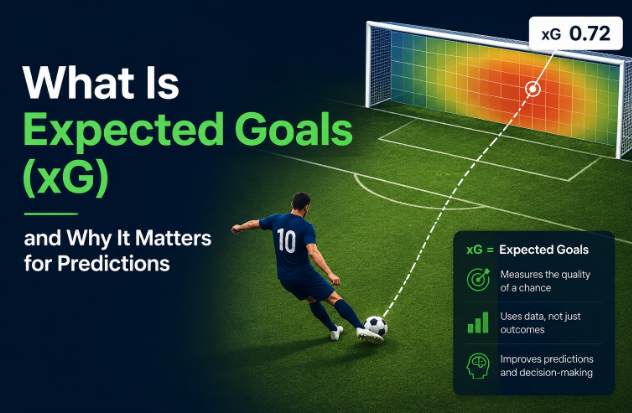
If you’ve spent any time watching football analysis online or following data-driven pundits, you’ve almost certainly come across the term “Expected Goals” or xG. It pops up on broadcast graphics, appears in post-match breakdowns, and has become a go-to metric for analysts trying to explain why a team won or lost. But for many fans and bettors, it still feels like a vague number floating on a screen with no real explanation behind it. This article breaks down what Expected Goals (xG) actually means, how it’s calculated, and crucially why it can be a genuinely useful tool when trying to make more informed predictions.
What Does xG Actually Mean?
At its core, Expected Goals is a measure of shot quality. Every time a player takes a shot in a football match, xG assigns that shot a probability score between 0 and 1, representing how likely it is to result in a goal based on historical data from thousands of similar shots.
A shot with an xG of 0.9, for example, is the kind of chance that gets scored nine times out of ten think of a tap-in from two yards out with an open goal. A shot with an xG of 0.03 is a long-range, low-probability attempt that most strikers would miss more often than not. When you add up all the xG values across every shot in a match, you get a total xG figure for each team — a rough estimate of how many goals each side “should” have scored based on the quality of the chances they created.
It doesn’t judge what actually happened. It judges what the data says should have happened.
How Is xG Calculated?
The xG model looks at a range of factors from every shot in its database to assign each new attempt a probability score. The most important variable is distance from goal shots taken closer to the keeper are statistically far more likely to go in. The angle of the shot matters too; a tight-angle shot from the byline has much lower conversion rates than a central attempt.
Beyond that, more sophisticated models factor in whether the shot came from open play or a set piece, whether it was taken with the head or foot, how many defenders were between the shooter and the goal, and whether it followed a cross, a through ball, or a dribble. Some models even account for the goalkeeper’s position at the moment of the shot.
A straightforward penalty, for instance, carries an xG of around 0.76 – not 1.0, because penalties are occasionally missed or saved. A Harry Kane header from the edge of the six-yard box following a precise cross might clock in at 0.65 or higher. Meanwhile, a speculative Trent Alexander-Arnold effort from 35 yards out might register at 0.02 or 0.03, no matter how well he strikes it.
Why Does xG Matter for Reading a Match?
This is where xG becomes genuinely interesting, both for analysing games and for building better predictions. The final scoreline in football can be misleading. A team can win 1–0 while being thoroughly outplayed, perhaps they scored from their only shot on target, a deflected effort from distance, while the opposition hit the post twice and had two goals disallowed. The scoreboard says one thing; the xG data tells a very different story.
A classic example came in the 2022–23 Premier League season, when Arsenal were regularly outperforming their xG early in the campaign and some analysts flagged that their goal output might regress which it eventually did in some stretches. Equally, in European football, teams like Bayer Leverkusen under Xabi Alonso became renowned for consistently generating high-quality chances, and their xG figures reflected their dominance long before trophy wins confirmed it.
For anyone thinking about predictions, this matters a lot. If Team A wins 3-0 but their xG was 0.8 and the opposition’s was 2.3, that scoreline probably doesn’t reflect the true shape of the match. The winning team overperformed their xG; the losing team underperformed theirs. Over a season, those numbers tend to even out — which means the next time those two sides meet, it might look very different.
How Bettors Can Use xG Responsibly
It’s worth being clear here: xG is not a formula for picking winners. Football remains unpredictable, and no model or metric can remove the uncertainty from the sport. What xG can do is help you move beyond surface-level thinking when assessing a team’s form or quality.
Say you’re looking at a team that has lost their last three matches and seems like they’re in terrible form. Before writing them off, it’s worth checking their xG across those games. If they were creating good chances but simply not finishing, their underlying performance may be stronger than the results suggest – meaning they could be undervalued in the market. On the flip side, a team on a five-game winning streak but consistently posting low xG figures might be riding their luck, and their results could turn.
Comparing a team’s actual goals scored versus their xG over a season also reveals whether a striker is genuinely clinical or just running hot. A forward scoring at 0.4 xG per 90 minutes but converting at a rate that implies 0.7 is likely outperforming what the chances alone would suggest which doesn’t mean they’ll stop scoring, but it’s worth factoring in.
Sites like Understat, FBref, and Sofascore all publish xG data for most top European leagues, and they’re free to access. Getting into the habit of cross-referencing results with xG figures — rather than just looking at the table — is one of the more practical ways to build a sharper understanding of the game.
Conclusion
Expected Goals isn’t a perfect science, and like any metric, it works best as one piece of a larger puzzle. But it represents a meaningful shift in how football can be understood – moving away from pure scorelines toward a more honest picture of which teams are genuinely creating and conceding quality chances. For fans, it adds a layer of nuance to match analysis. For bettors, it provides context that raw results simply can’t offer on their own. Understanding xG won’t make every prediction right, but it will make your thinking about the game a good deal sharper.
Disclaimer: This article is intended for educational purposes only and is aimed at helping readers better understand football statistics. Nothing written here constitutes betting advice, and no outcome in football or sports betting can be predicted with certainty. Betting carries financial risk, and you should only ever wager what you can afford to lose. If you feel that gambling is becoming a problem, please seek support from a responsible gambling organisation in your region.