
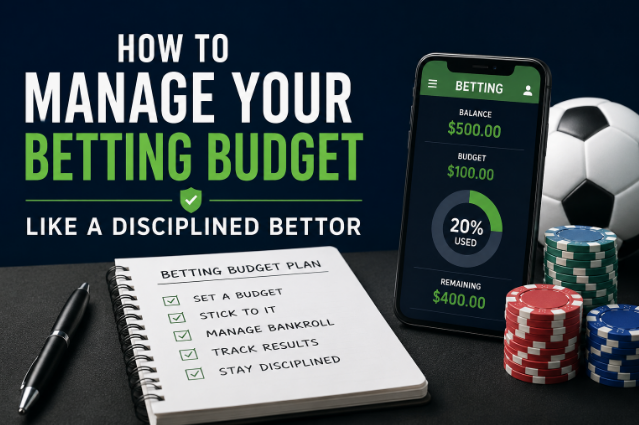
Most people who start betting on football do so with good intentions. They watch the games closely, they understand formations, they know which teams are in form and they back their judgement with money. But somewhere along the line, things go sideways. Not because their football knowledge was wrong, but because they never had a plan for their money. Knowing how to manage your betting budget like a disciplined bettor is arguably more important than any match prediction you’ll ever make.
This article walks you through the core principles of betting bankroll management, in plain English, with real football context – so you can approach your bets with structure, not just instinct.
What Is a Betting Bankroll and Why Does It Matter?
Your bankroll is simply the total amount of money you’ve set aside specifically for betting — separate from your rent, your food budget, your savings. Think of it like a starting squad. If you burn through your best players in the first twenty minutes, you’ve got nothing left for the second half.
The size of your bankroll doesn’t matter nearly as much as the discipline you apply to it. Someone betting with ₦50,000 who manages it well will outlast someone with ₦500,000 who throws random amounts at every game. Before you place your next bet, decide on a fixed amount that you’re comfortable losing entirely. That’s your bankroll. Once it’s gone, you stop full stop. This isn’t pessimism; it’s the same logic a football club uses when setting a transfer budget. You work within your limits.
Set a Staking Plan Before You Bet Anything
A staking plan is simply the rule you follow for deciding how much to bet on each selection. Without one, most people either over-bet when they feel confident or chase losses by increasing stakes – both of which are fast routes to a depleted account.
The most widely used method among disciplined bettors is flat staking, where you bet the same percentage of your bankroll on every wager, regardless of how confident you feel. A common starting point is 1–3% per bet. So if your bankroll is ₦100,000, a 2% stake means you’re placing ₦2,000 per bet. That might sound conservative, but consider this: even if you hit a run of ten consecutive losses, which can happen even when you’re making smart selections — you’d still have ₦80,000 remaining to recover from. Compare that to someone throwing ₦15,000 on every match; ten losses and they’re practically starting over.
Another approach is the percentage staking method, where your stake adjusts as your bankroll grows or shrinks. If your ₦100,000 grows to ₦120,000, your 2% stake becomes ₦2,400 automatically. This method grows your stake as you win and protects you as you lose. Either approach beats going on feel alone.
Understand the Difference Between Value and Confidence
This is where many football bettors go wrong. There’s a big difference between thinking a team will win and thinking a team offers value at the price the bookmaker is offering.
Here’s a simple example. Suppose Manchester City are playing a mid-table side at home. You’re confident City will win but the bookmaker has priced them at 1.25 (meaning you’d win ₦25 for every ₦100 you stake). Now ask yourself: does the likelihood of City winning actually justify that return? At 1.25, the implied probability of City winning is 80%. If you honestly think their chance of winning is closer to 65–70%, then the bookmaker’s price doesn’t reflect reality – there’s no value there, even if City do end up winning.
Disciplined bettors aren’t just looking for teams they believe will win. They’re looking for situations where the bookmaker’s price underestimates a team’s true chances. Value betting is about the price, not just the outcome. Over a large number of bets, backing value consistently is what separates bettors who last from those who burn out.
Keep Records of Every Bet You Place
This one sounds tedious, but it’s the single most effective habit a bettor can build. Write down every bet you place — the match, the selection, the odds, the stake, and the outcome. Review it weekly or monthly.
Why? Because memory lies to us. Most people remember their winning bets more vividly than their losses. Without records, you genuinely cannot tell whether your football instincts are actually profitable or whether you’ve been getting lucky. Keeping records gives you real data. Maybe you’ll discover that your Premier League bets are profitable but your Champions League bets consistently drain your bankroll. Maybe you’ll notice that your bets placed on Friday evenings — when you’re tired after the week — lose at a higher rate than those placed with a clear head on Saturday morning.
This kind of review is exactly what football clubs do. They don’t rely on gut feeling to analyse performance — they study the data and adjust. You should do the same.
Protect Yourself From Emotional Betting
The most dangerous moment in betting isn’t when you’ve lost three times in a row — it’s the moment you decide to “win it back” in one go. That’s where bankrolls die. You double your stake, pick a riskier game, and tell yourself this one will fix everything. It rarely does.
Emotional betting almost always follows a loss. Arsenal fans know this feeling well — watching their side concede a late equaliser and immediately wanting to back them to “make up for it” in the next fixture. But the football didn’t owe you anything, and neither does the next bet. Every wager should be evaluated on its own merits, not on what happened before it.
A practical way to manage this is to set a daily or weekly loss limit alongside your bankroll. Decide in advance: “If I lose more than ₦10,000 in a week, I stop betting until the following week.” This creates a circuit breaker before emotion takes over. Some bettors also find it helpful to step away entirely after a significant loss — a day or two of not betting at all, just watching the football for what it is.
Conclusion
Managing your betting budget isn’t the most exciting part of following football, but it’s what keeps the experience sustainable. Start with a fixed bankroll that you can genuinely afford to lose. Use a staking plan, whether flat or percentage-based, so emotion doesn’t dictate your stake size. Learn to recognise value rather than just confidence. Track every bet you place and review that data honestly. And build in limits that protect you from the natural human impulse to chase losses.
The bettors who last longest aren’t always the ones with the sharpest football knowledge. They’re the ones who treat their bankroll with respect, stick to a plan, and stay consistent even when results don’t go their way. Discipline isn’t a talent, it’s a habit you can build.
Disclaimer: This article is intended for educational purposes only and is aimed at adults who are legally permitted to bet in their jurisdiction. Betting involves financial risk, and there is no method, strategy, or system that removes that risk entirely. Past performance does not predict future outcomes. If you feel your betting is becoming difficult to control, please seek support from a responsible gambling organisation in your region.