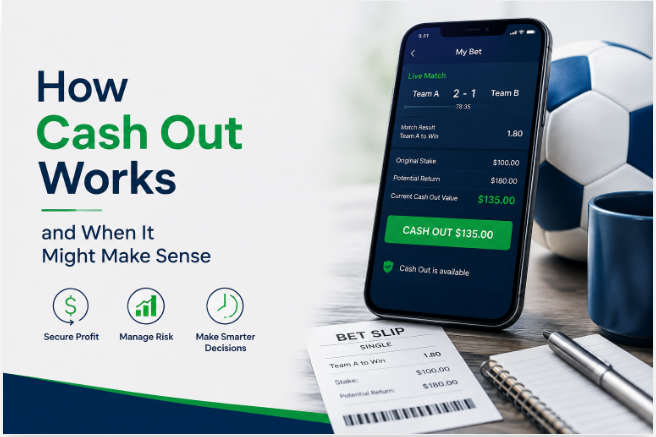
Most football bettors have stared at a live match, bet slip open, cash out value flashing, wondering whether to take it. The bet cashout feature has become one of the most-used tools on modern betting apps, and yet a surprising number of people use it without really understanding the mechanics behind the number they’re being offered. That gap between using a feature and understanding it is where most of the regret comes from.
This piece breaks down how cash out actually works, what shapes the price you’re shown, and the situations where taking it – or leaving it – tends to make more sense than the alternative.
What Bet Cashout Actually Is
Cash out is an option offered by most bookmakers that lets you settle a bet before the event it’s based on has finished. Instead of waiting for full-time and letting the original odds determine your payout, you accept an offer from the bookmaker to close the bet early, either for a profit or a reduced loss.
It’s important to understand that this offer isn’t just “your winnings so far.” It’s a calculated figure based on live odds, the bookmaker’s own margin, and how the market currently views the remaining outcome. That last point matters a lot, and it’s where a lot of confusion comes from.
The Math Behind the Offer
When you place a bet, the bookmaker effectively holds a liability tied to your stake and the odds at the time. As the match progresses, the live odds shift – a red card, an early goal, or a tactical substitution can all move the market. The cash out value reflects what it would cost the bookmaker to “buy back” your position at current odds, minus their margin.
This is why cash out offers are almost always slightly less generous than a purely neutral calculation would suggest. That margin is the bookmaker’s built-in edge, and it’s present whether you’re cashing out a Premier League acca in the 70th minute or a Champions League single in stoppage time.
Why Cash Out Feels More Tempting in Football Specifically
Football lends itself to cash out psychology in a way that some other sports don’t. A single goal can completely flip a match’s momentum and its live odds, and there’s often a long stretch of play — sometimes 20 or 30 minutes — where nothing decisive happens but anxiety builds anyway.
Think about a bet on a heavy favorite like a top La Liga side away at a mid-table opponent. If they go 1-0 up inside 15 minutes, the cash out value might jump quickly. But there’s still 75+ minutes of football left, plenty of time for an equalizer, a red card, or a manager’s tactical gamble to change everything. That long window is exactly why cash out exists as a product – bookmakers know the emotional pull of “locking in” a result is strong, especially in a sport where 90 minutes can feel like a very long time to sit with uncertainty.
When Cashing Out Might Make Sense
There’s no universal rule here, but a few patterns come up often enough in match analysis to be worth naming.
Genuine Change in Match Context
If the actual conditions of the match have shifted in a way that changes the picture your original bet was based on – a key player forced off through injury, a red card against the side you backed, or a tactical switch that clearly favors the opponent – the original logic behind your bet may no longer hold. In that case, cashing out isn’t about fear, it’s about updating your view based on new information.
Locking In Value on a Multi-Leg Bet
Accumulator or parlay-style bets carry compounding risk with every added leg. If four of your five selections have already come in and the fifth is a tight, live 50/50 situation, cashing out partially can make sense simply because one dodgy penalty decision or a stoppage-time set piece can undo the entire ticket. Many experienced bettors treat multi-leg cash out less as an emotional escape and more as basic risk management on bets where variance is naturally higher.
Protecting a Position When the Match Has Turned Chaotic
Some matches become genuinely unpredictable – end-to-end, cards flying, both sides pushing. When a game shifts from a controlled, tactical contest into something closer to a coin flip, the original odds-based logic weakens. This is a defensible moment to consider cashing out, not because you’re scared, but because the framework you built your prediction on has changed.
When Cash Out Tends to Work Against You
The flip side matters just as much, and it’s the part that gets glossed over in most casual discussion of the feature.
Cashing Out Purely on Nerves
The most common misuse of cash out isn’t strategic – it’s emotional. A bettor sees a live score go against the run of play, panics, and cashes out at a poor price even though nothing about the actual match data justifies the reaction. This is worth being honest about: cash out can quietly reward anxiety rather than analysis if you’re not careful.
Repeated Small Cash Outs Eroding Value
Because the bookmaker’s margin is baked into every cash out offer, using the feature frequently – especially on bets that were fundamentally sound – tends to shave long-term value off a betting strategy. One cash out here or there is a normal risk-management tool. Making it a habit on nearly every live bet is a different pattern, and it’s one worth watching in yourself over time.
Cashing Out Too Early on a Well-Reasoned Bet
If your original prediction was built on solid pre-match analysis – team news, form, tactical matchups – and the match is simply playing out slowly rather than against you, an early cash out can mean abandoning a good decision because the scoreline hasn’t caught up yet. This is common in low-scoring competitions where a 0-0 at halftime doesn’t necessarily mean your backed team is losing control of the game.
A Practical Way to Think About It
A useful habit is asking one question before touching the cash out button: has anything actually changed about the match itself, or has only the scoreline and my own comfort level changed? If it’s the latter, that’s usually a signal to sit with the original bet rather than react to it.
This is also where responsible betting habits matter. Cash out isn’t a way to guarantee a result or eliminate risk entirely – it’s a tool for adjusting exposure, and it works best when used deliberately rather than as a reflex. Treating it as part of a broader, considered approach to betting (rather than a panic button) tends to serve bettors better over the course of a season.
F.A.Q
Does cashing out always guarantee a profit?
No. Cash out can also be used to lock in a partial loss rather than risk losing the full stake, depending on how the match is unfolding relative to your original bet.
Why is the cash out value sometimes lower than expected?
The offer reflects live odds and the bookmaker’s built-in margin, not just a simple recalculation of your potential winnings. That margin is why cash out prices are rarely as generous as bettors initially expect.
Is it better to cash out or let the bet run to full-time?
It depends on whether the underlying situation has genuinely changed. If the match context is the same as when you placed the bet, letting it run is often more consistent with your original analysis than reacting to a temporary scoreline.