
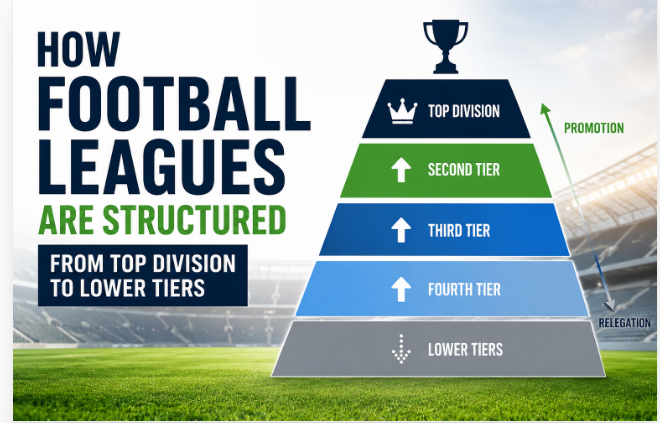
If you’ve ever placed a bet on a football match or thought about it you’ve probably noticed that odds, team strength, and match unpredictability can vary wildly depending on which league you’re looking at. That’s not a coincidence. Understanding how football leagues are structured from top division to lower tiers is one of the most underrated pieces of knowledge a bettor can have. It shapes everything: the quality of play, the availability of statistics, the financial gap between clubs, and even how motivated teams are at different points of the season.
The Pyramid Model: How Leagues Are Organised
Most football associations around the world use what’s often called a “pyramid” system. At the top sits the most prestigious division think the English Premier League, Spain’s La Liga, or Germany’s Bundesliga. Below that sits a second tier, then a third, and so on, sometimes stretching down ten or more levels in countries like England.
Each level of the pyramid typically contains a fixed number of clubs. England’s Premier League, for instance, has 20 teams. Below it sits the Championship, then League One, then League Two, and further down into the non-league pyramid. The further down you go, the more clubs there are competing across that level, and the more regional the competition often becomes. In countries with smaller football cultures, the pyramid may only have three or four professional levels before reaching amateur football entirely.
Promotion and Relegation: The Engine of the System
What makes the pyramid genuinely compelling and relevant to betting is the mechanism that connects each level: promotion and relegation. Finish near the top of your division and you move up; finish near the bottom and you drop down. This isn’t just sporting drama. It has serious financial consequences for clubs, and those consequences directly influence how teams approach matches.
Take the English Championship as an example. The difference in prize money and broadcasting revenue between playing in the Championship and the Premier League runs into tens of millions of pounds. Clubs fighting to avoid relegation from the Premier League or chasing promotion from the Championship are often playing with enormous financial stakes on the line. This tends to produce competitive, hard-fought matches sometimes making outcomes harder to predict than those mid-table Premier League games where neither side has much to play for.
Understanding where a team sits in the context of promotion or relegation pressure can help you interpret their form and motivation more accurately, which is a genuinely useful lens when assessing any match.
How Lower Divisions Differ From the Top Flight
Once you drop below the elite level, the football changes quite a bit and so does the information available to bettors. Top-flight leagues attract extensive media coverage, detailed statistics, and consistent injury reporting. Clubs in the Premier League or La Liga have large medical and scouting departments, making their data more reliable and widely reported.
In the lower tiers, things get murkier. A League Two side in England or a third-division club in France might have far less detailed public data. Squad depth is thinner, which means a single injury to a key player can have a disproportionate effect on performance. Pitch quality can vary. Travel distances between clubs in lower regional leagues can be significant, affecting player fatigue.
That variability cuts both ways. Some experienced bettors actively prefer lower divisions because the market odds set by bookmakers may be less precise bookmakers invest more analytical resources in top-flight matches. But that same lack of information can make results more volatile and harder to assess with confidence.
Cup Competitions and Cross-Tier Matchups
One of the most fascinating features of the football pyramid is what happens when clubs from different divisions meet in cup competitions. In England, the FA Cup famously allows non-league sides clubs operating several levels below the professional game to face Premier League opponents. These “giant-killing” scenarios happen regularly enough to be a legitimate part of football culture.
For anyone thinking about betting on cup matches, cross-tier fixtures require a different kind of analysis. A Premier League club might rotate their squad heavily, particularly in early rounds, which can level the playing field considerably. Meanwhile, a lower-division side playing at home in a cup tie often benefits from crowd intensity and the absence of relegation pressure they’re playing freely, with nothing to lose. The 2023 FA Cup run by Sheffield Wednesday (then in the Championship) and historical upsets involving non-league sides are reminders that tier alone doesn’t determine the outcome of a specific match.
Why League Structure Matters When Making Betting Decisions
Putting all of this together, the structure of a football league system tells you things that raw match statistics sometimes can’t. Knowing that a team is in a playoff position with three games left explains their urgency. Knowing that a top-flight club is already mathematically safe from relegation tells you something about their likely intensity. Understanding that a fourth-tier side is facing a Premier League club in a cup match and that the Premier League side is fielding their reserve squad — is context that shapes what a realistic outcome looks like.
None of this information makes any outcome certain. Football, more than almost any other sport, produces surprises. But building a picture of the league structure around a match where the clubs are in the table, what they’re playing for, which division they’re in, and how the pyramid connects them gives you a more honest foundation for your thinking.
Conclusion
Football leagues aren’t just administrative structures they’re ecosystems with their own financial pressures, competitive dynamics, and information landscapes. From the elite top divisions with their enormous broadcast deals and global scouting networks, down to the regional lower tiers where a rainstorm on match day or a surprise team selection can shift everything, the pyramid shapes how football is played and experienced at every level. For anyone looking to engage with football more thoughtfully, whether watching, analysing, or betting, understanding how these leagues connect and what drives clubs within them is a genuinely valuable starting point.
Disclaimer.
This article is intended for educational purposes only. It does not constitute betting advice, and no content within it should be interpreted as a recommendation to place any specific wager. Football betting involves financial risk, and outcomes are never predictable with certainty. Always bet responsibly, within your means, and in accordance with the laws and regulations applicable in your region. If you feel gambling is negatively affecting your life, please seek support from a qualified organisation in your area.