
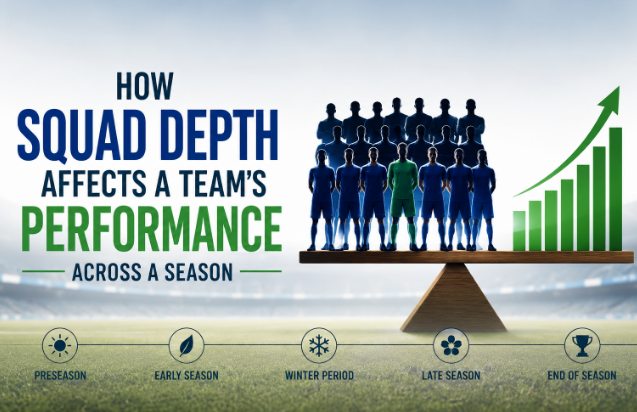
When people talk about why a football club wins or loses a title race, or why a side that looked brilliant in October is suddenly struggling in February, the conversation almost always comes back to the same thing: squad depth. Understanding how squad depth affects a team’s performance across a season is one of the more underrated areas of football analysis – and it’s one that bettors, particularly those focused on the second half of the season, can genuinely benefit from thinking about. This article breaks down what squad depth actually means in practice, why it matters at different points in a campaign, and how it can shape the outcomes of individual matches in ways that aren’t always obvious from the team sheet alone.
What Squad Depth Actually Means in Practice
Squad depth isn’t simply about having a lot of players, it’s about having quality throughout the roster, not just in the starting eleven. A club with fifteen world-class players in its first-choice lineup but thin, inexperienced cover beyond that is actually more vulnerable than it might appear. Real depth means that when the twelfth, thirteenth, or fourteenth player steps in, the drop-off in quality is minimal enough that the team’s overall performance level holds.
Manchester City under Pep Guardiola have built their dominance in English football in part because of this very principle. In multiple title-winning seasons, their ability to rotate players across the Premier League, FA Cup, Champions League, and League Cup without significantly weakening the side has been a key competitive advantage. When Bernardo Silva plays instead of Kevin De Bruyne, or when Rico Lewis rotates into the fullback position, the team’s structure doesn’t collapse – it adapts. That’s what genuine squad depth looks like in action.
For smaller clubs without that level of resources, the picture is very different. A Championship side promoted to the Premier League often has a strong first eleven but limited quality beyond it, which is why you frequently see newly promoted teams performing well in the first two months of a season before gradually fading as injuries and fatigue begin to bite.
The January Dip and Fixture Congestion
If you pay attention to football closely enough, you’ll notice a recurring pattern: squads with limited depth tend to hit a wall somewhere between December and February. This is no coincidence. The festive fixture period in England, for instance, sees clubs playing every two or three days for several weeks, with no winter break to recover. In Europe, the picture is even more demanding for clubs in continental competition.
Fatigue isn’t just physical – it affects decision-making, reaction times, and the kind of concentration that prevents soft goals. A tired centre-back hesitates for a half-second longer than usual. A winger who has played 90 minutes every three days for six weeks stops making the overlapping runs that created chances in August. These aren’t dramatic collapses; they’re gradual erosions of performance that show up quietly in results.
Tottenham Hotspur have experienced this in several recent seasons – promising starts followed by inconsistency in the congested winter months, partly because their squad hasn’t always had the depth to maintain intensity across multiple fronts simultaneously. For bettors, this period of the season is worth paying close attention to. Teams heavily reliant on ten or eleven players tend to become more vulnerable in this window, especially in fixtures where they might otherwise have been favoured.
How Injuries Expose Thin Squads
The relationship between injuries and squad depth is perhaps the most direct and visible connection in football. Every squad will deal with injuries across a long season — that’s unavoidable. What separates clubs is how much quality they can still put on the pitch when three or four key players are unavailable simultaneously.
Liverpool’s 2020/21 Premier League season is a stark example. After winning the title convincingly the season prior, they suffered a catastrophic injury crisis in central defence, losing Virgil van Dijk, Joe Gomez, and Joel Matip in the same period. The depth behind those players wasn’t sufficient to absorb those losses, and the effect on the team’s performance was dramatic. From a side that had looked nearly unbeatable, they became one of the leakiest defences in the division for a spell – not because the manager changed, the tactics changed, or the culture changed, but because the players needed to execute those tactics simply weren’t available.
For anyone analysing a match before placing a bet, checking the injury list goes hand in hand with understanding how much depth a club has in the affected positions. Losing a holding midfielder hurts a team with no natural replacement far more than it hurts a club with two quality options in that role.
Squad Depth and End-of-Season Implications
The final stretch of a season – typically March through May is where squad depth separates title contenders from the rest, and often where relegation battles are truly decided. Teams chasing European places are often playing Thursday-Sunday fixtures, which compresses recovery time. Clubs in relegation scraps are dealing with the mental and physical toll of months of pressure and high-stakes matches.
Arsenal’s 2022/23 title challenge ultimately fell away in the closing months of the season, and while several factors contributed, the lack of experience and depth in certain key positions became more visible as the games came thick and fast. Meanwhile, Manchester City with broader, more seasoned options throughout the squad — kept their standards consistent when it mattered most.
For bettors looking at late-season fixtures, it’s worth asking which teams are running on fumes and which still have something in reserve. A side that has rotated intelligently and maintained fitness across the squad will often outperform expectations in April and May, while a team that has relied heavily on its first-choice players throughout might be showing the strain precisely when results matter most.
Conclusion
Squad depth is one of those factors in football that only becomes truly visible when it’s tested by injuries, by congested schedules, or by the sheer accumulation of a long, demanding season. For bettors, keeping an eye on how well-stocked a team is beyond its starting eleven, particularly during the winter fixture crunch and the run-in, adds a meaningful layer to match analysis. A team’s form in September doesn’t always predict their form in March, and the difference is often found not in tactics or motivation, but in whether the right players are available and fresh enough to execute. It’s a less glamorous area of analysis than studying tactics or head-to-head records, but it’s one of the more reliable indicators of how a season and individual matches within it is likely to unfold.
Disclaimer: This article is intended for educational purposes only and does not constitute financial or betting advice. Betting on football involves risk, and no analytical approach can predict outcomes with certainty. Please gamble responsibly and only with money you can afford to lose. If gambling is negatively affecting you or someone you know, contact a responsible gambling support service in your region.