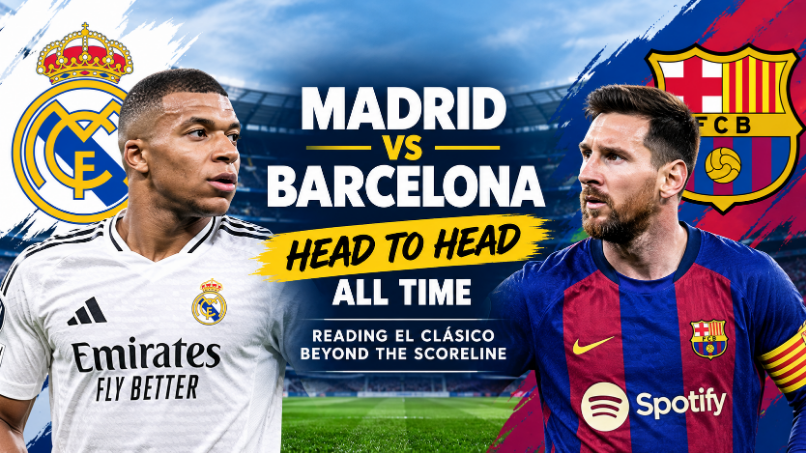
Few fixtures in world football carry the weight of Real Madrid vs Barcelona. More than a century of meetings have produced one of the most closely contested rivalries in the sport, and the Madrid vs Barcelona head to head record reflects exactly that – a series so tight that it has swung back and forth for decades rather than settling into one side’s clear advantage.
This isn’t a case of one club dominating the other over time. It’s closer to two heavyweight boxers trading rounds across generations, with different eras, different stars, and different tactical approaches shaping who came out ahead at any given point. Understanding that balance, and why it keeps shifting, matters more than memorizing a single win-loss tally that will likely be outdated by the next Clásico anyway.
Why the Head-to-Head Record Keeps Changing Hands
Anyone searching for an exact, permanent Real Madrid vs Barcelona head-to-head number will run into a frustrating reality: the figures genuinely differ depending on the source, the date it was published, and whether friendlies or Spanish Super Cup fixtures are included.
What’s consistent across nearly every reputable tracker is the overall picture – this is a series decided by a handful of wins either way, not a lopsided rivalry. At various points over the last decade, Barcelona has pulled level with or edged ahead of Real Madrid in all-competition meetings, only for Madrid to respond and retake a slim lead, and the cycle has repeated more than once. That tells you something more useful than any single snapshot number: this rivalry rarely stays settled for long.
For context, that’s a different pattern than you see in some other historic derbies. Manchester United’s head-to-head record against most Premier League rivals, for instance, has generally leaned one direction for extended stretches. El Clásico doesn’t really work that way – it corrects itself almost every time one side builds a cushion.
The La Liga Picture Specifically
Within La Liga itself, the head-to-head has followed the same tight pattern, with Real Madrid generally holding a modest edge in league meetings specifically, while the overall all-competitions picture has narrowed or flipped depending on cup and Champions League results layered on top. Draws have also made up a meaningful share of these league meetings – often somewhere in the range of a quarter of all matches, which fits the broader theme of two evenly matched sides cancelling each other out.
Cup Competitions Tell a Slightly Different Story
Where the two clubs’ paths diverge more clearly is in the Copa del Rey, Spain’s primary domestic cup. Barcelona has historically held the better record in that competition specifically, a pattern that’s persisted across different eras and squads rather than being tied to one golden generation.
This matters for anyone trying to understand the rivalry properly rather than just the headline number. A club can trail in the overall tally while still owning a clear edge in one specific competition, and that nuance gets lost if you only look at the combined all-time figure. The same logic applies in reverse in continental competition, where Real Madrid’s broader Champions League pedigree has generally translated into a slight edge in their European meetings with Barcelona as well.
What Actually Decides Recent Clásicos
Beyond the historical ledger, patterns in how Clásicos actually play out tend to matter more for anyone trying to understand the fixture today than century-old results do.
Squad depth and fitness windows. Both clubs typically field rosters packed with internationals who’ve played heavy midweek schedules in the Champions League or for their national teams. Fatigue and rotation decisions around a Clásico weekend can shift a match more than people expect, the same way they do before any Premier League “Big Six” fixture.
Managerial approach at full-back and midfield. Clásicos are frequently decided by which side wins the battle in wide areas and central midfield rather than by individual moments alone. A manager who sets up to press high against Barcelona’s build-up play, or one who sits a mid-block against Madrid’s transition speed, tends to shape the whole match before a ball is even kicked in anger.
Context within the season. A Clásico played with both teams fighting at the top of the table tends to look very different from one played when a title race has already been decided. Intensity, risk-taking, and squad rotation all shift depending on what’s actually at stake that week, a factor that applies to almost every major rivalry fixture in European football, not just this one.
Why This Matters Beyond the History Lesson
Knowing that the head-to-head record is close and constantly shifting is useful context, but it shouldn’t be mistaken for a predictive tool on its own. A tight all-time series tells you this fixture is historically competitive – it doesn’t tell you how either side is actually set up to play this specific weekend.
The more practical approach is treating historical head-to-head data as background context, then layering in current form, team news, and tactical matchups closer to kick-off. This is a principle worth applying to any major derby, not just this one: history explains why a fixture carries extra weight, but it rarely explains what’s going to happen in the next 90 minutes. Markets around a fixture this unpredictable should always be approached with that uncertainty in mind, treating any prediction as informed analysis rather than a guaranteed outcome, and staying mindful that following these matches closely is meant to add to the experience of watching, not replace responsible judgment around risk.
Conclusion
The Real Madrid vs Barcelona head-to-head record is, fittingly, one of the most balanced rivalries in football history, a series that has rarely let either club pull decisively clear for long. Real Madrid have generally held a slim edge in combined all-time meetings and in European competition, while Barcelona’s stronger Copa del Rey record and periods of league dominance have kept the overall picture remarkably close.
For anyone following El Clásico, the real value isn’t in memorizing one headline number that will shift again at the next meeting. It’s in understanding why this fixture has stayed so evenly matched for over a century, and in reading each new meeting through current form and tactics rather than historical weight alone.
FAQ
Who has more wins all time, Real Madrid or Barcelona?
The all-competitions record has stayed remarkably close for years, with the two clubs separated by only a handful of wins and the lead changing hands more than once over the past decade – it’s genuinely one of the tightest major rivalries in football.
Does Real Madrid or Barcelona have the better record in La Liga specifically?
Real Madrid has generally held a modest edge in their direct La Liga meetings over the full history of the rivalry, though the gap has narrowed during Barcelona’s strongest periods.
Why does the Clásico head-to-head record keep changing so often?
Because the two clubs have remained closely matched across different eras and managerial cycles, with neither side able to build a lasting advantage before the other responds – a pattern that’s held for most of the rivalry’s history.